When you’re planning a high-performance home in Canada, energy modelling is one of the most valuable tools available before construction begins. Whether you’re building a Passive Home, pursuing Net Zero performance, or aiming for a higher code tier, modelling helps predict how the home will use energy based on its design, climate, envelope, and mechanical systems. At greencanadaenergy, we use energy modelling to help project teams evaluate design choices early, when changes are still practical and cost-effective.
Across Canada’s diverse climates, the difference between expected and actual performance often comes down to decisions made during design. Energy modelling allows builders and homeowners to compare insulation levels, window specifications, airtightness targets, and mechanical systems before construction starts, reducing uncertainty and supporting better long-term performance.
How Residential Energy Modelling Works in Canada
The most widely used simulation tool for low-rise residential projects is HOT2000, developed and maintained by Natural Resources Canada (NRCan). It models the full thermal envelope — walls, roof, foundation, windows, and doors — alongside mechanical systems including heating, cooling, domestic hot water, and ventilation. The software runs a whole-house energy analysis and generates an annual energy use estimate in gigajoules per year, which forms the basis of the EnerGuide rating calculation. HOT2000 is well suited for typical Canadian wood-frame residential compliance, though it accounts for framing effects and effective R-value assumptions rather than detailed junction-level thermal bridging. More complex assemblies or Passive House projects typically call for more specialized tools.
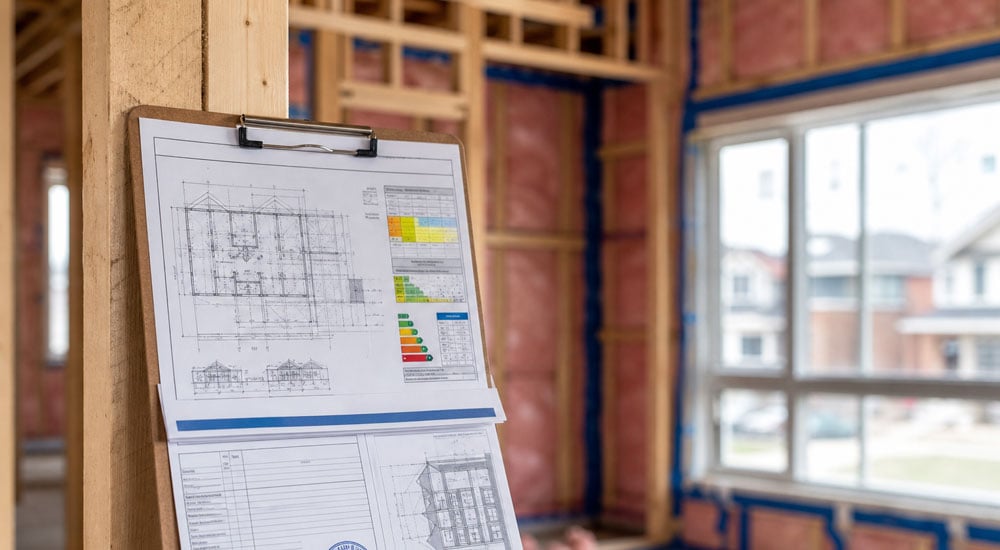
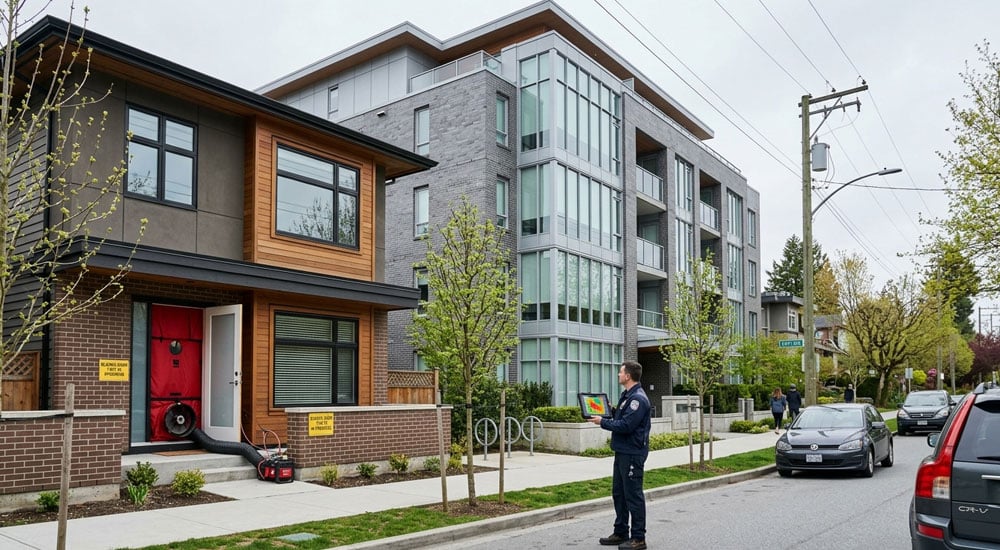
The process usually unfolds in two stages. First, an energy advisor registered with NRCan builds a pre-construction model using the design drawings. This identifies which building components have the most impact on performance and gives the team room to refine the design before it’s locked in. After construction, a blower door test measures actual airtightness, and a post-construction model is finalized and submitted through the EnerGuide system to confirm the home meets the required performance tier.
| Modelling Tool | Best Use Case | Common Certification Path | Thermal Bridge Detail |
| HOT2000 | Low-rise residential (Part 9) | EnerGuide, ENERGY STAR, R-2000 | Framing effects and effective R-value |
| PHPP | Passive House projects | Passive House Canada | Explicit junction thermal bridge inputs |
| DesignBuilder / EnergyPlus | Complex Part 3 buildings | LEED, advanced performance modelling | Highly detailed |
Building Envelope Performance and Airtightness
The building envelope — walls, roof, foundation, windows, and the air barrier system — is where most high-performance homes either succeed or fall short. In Canada’s cold climate, heat loss through the envelope accounts for a substantial share of annual energy use, and modelling quantifies that loss before the design is finalized.
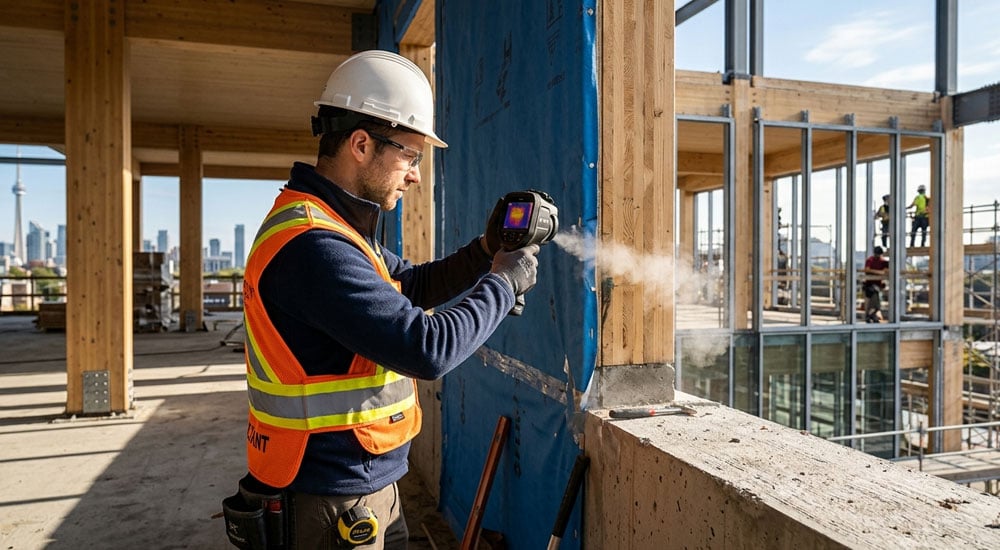
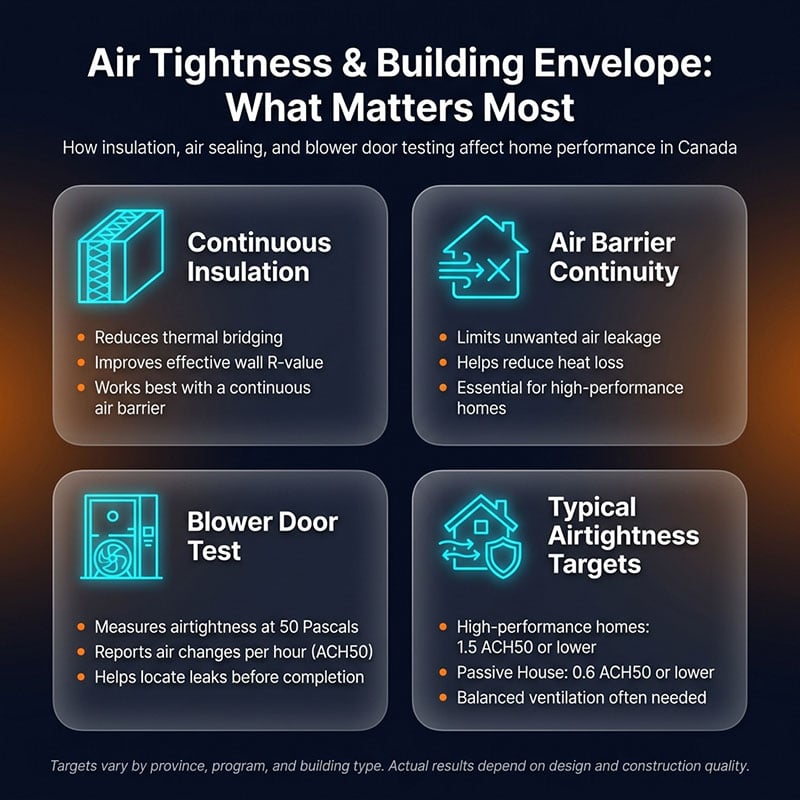
Continuous insulation is one of the most effective envelope strategies because it reduces heat loss through framing, junctions, interfaces, and slab edges — not just through wall cavities. A model comparing the same wall assembly with and without continuous insulation can show a meaningful difference in effective R-value and annual heating load. Continuous insulation works best when detailed alongside air-barrier continuity and moisture management, since these three elements reinforce each other in practice.
Airtightness is equally significant. The blower door test is typically conducted during or near the end of construction, and sometimes earlier to identify air-sealing issues before they become harder to address. It measures air changes per hour at 50 Pascals (ACH50). Common airtightness reference points in Canadian residential construction include:
- High-performance homes: often targeting 1.5 ACH50 or lower
- Passive House certification: 0.6 ACH50 or lower
- Advanced programs such as R-2000 or net-zero-ready homes: require verified airtightness under program-specific criteria
- Conventional builds: airtightness expectations vary by province, compliance path, and program
The energy model uses the tested airtightness value as an input, so tighter construction translates directly into a better modelled outcome. In well-sealed homes, balanced mechanical ventilation with heat or energy recovery — HRV or ERV — is essential for indoor air quality. Ontario’s updated residential ventilation requirements have made heat and energy recovery systems increasingly standard in new home construction, though applicability varies by building type and compliance path.
Certification Programs, Incentives, and Code Direction in Canada
Canada’s residential performance landscape includes several certification streams, each with its own energy modelling requirements and performance targets. Understanding the differences helps builders and homeowners select the right path for their project.
EnerGuide is the foundation. Almost every high-performance program in Canada either uses or references the EnerGuide Rating System, which expresses a home’s performance in GJ/year — the lower the number, the better. The ENERGY STAR for New Homes standard, administered by NRCan, sets performance requirements that typically result in homes being roughly 20% more energy efficient than those built to minimum code levels, depending on the program version and regional specifications. R-2000 goes further, requiring verified airtightness and high energy performance under NRCan program criteria, alongside additional indoor air quality requirements. The CHBA Net Zero Home label targets homes that generate enough on-site renewable energy to offset annual consumption entirely.
Beyond certification, an EnerGuide evaluation by a registered energy advisor is also the gateway to federal and provincial financial incentives. Programs like the Canada Greener Homes Affordability Program and various provincial rebate streams — including CleanBC and utility-delivered programs in Ontario — require a pre- and post-retrofit EnerGuide assessment to confirm performance improvements before issuing grants or rebates. For homeowners planning upgrades such as insulation, windows, or heat pump installation, the energy modelling process is not just a technical step; it’s what unlocks access to available funding.
At the code level, the 2020 National Model Codes established a five-tier energy performance framework for residential buildings, with Tier 5 representing net-zero energy-ready construction. The 2025 National Model Codes, released by the National Research Council, build on that foundation — adding prescriptive pathways for higher tiers, a new Energy Use Intensity compliance option, and provisions for alterations to existing buildings. Provincial adoption timelines vary: Ontario incorporated NBC 2020 into its building code in January 2025, while BC’s Energy Step Code has required performance-based compliance for most new residential projects since 2023. Across provinces, the direction is consistent higher tiers, tighter envelopes, and energy modelling as a standard part of the compliance process. The long-term national aspiration remains net-zero energy-ready construction by 2030.
The Value of Early Modelling in the Design Process
One of the most consistent findings among energy advisors and building scientists across Canada is that the earlier modelling enters a project, the better the outcome — and the lower the cost of reaching it. Decisions made at the schematic design stage, such as building orientation, window-to-wall ratio, and wall assembly depth, have an outsized effect on the final energy model. Making those changes at the design stage costs almost nothing. Making them during construction is significantly more expensive.
Energy modelling also helps compare options before committing to them. Upgrading from double-pane to triple-pane windows, improving airtightness, or switching from a gas furnace to a cold-climate heat pump can all be evaluated in the model before construction begins. The goal isn’t to predict the exact utility bill it’s to show which upgrades deliver the strongest performance benefit for the budget, and to give the client a clear picture of what they’re building and why. In leading projects, that analysis is increasingly paired with embodied carbon considerations, as design teams look at the full lifecycle impact of material choices alongside operational energy targets.
For projects targeting CHBA Net Zero or Passive House standards, the modelling process becomes a communication tool as well. It lets the design team walk clients through the specific choices that drive performance why a particular window specification matters, how the airtightness target affects HVAC sizing, or what the projected operating cost difference looks like between two insulation strategies. That kind of evidence-based conversation is increasingly what Canadian homeowners expect when they invest in high-performance construction.
Conclusion
Residential energy modelling is not just a compliance checkbox — it’s the foundation of any serious high-performance home project in Canada. Whether the goal is meeting a provincial performance tier, achieving EnerGuide or ENERGY STAR certification, building to Passive House or net-zero-ready standards, or accessing available retrofit incentives, modelling gives builders and homeowners the information they need to make confident, well-informed design decisions. As Canadian housing moves toward net-zero energy-ready standards, energy modelling is becoming less of a specialized service and more of a core part of responsible residential design.