If you’re planning a new build or a major retrofit, you’ve likely come across two terms that get used somewhat interchangeably: Passive House and Net Zero. Both aim for lower energy bills and a smaller environmental footprint, but they’re built on different ideas, and the difference matters once you start pricing things out. Passive House is built around passive home design principles, using a highly insulated, airtight envelope to dramatically reduce heating demand. Net Zero combines an efficient home with on-site solar generation, with performance verified through an EnerGuide rating. Which approach makes more sense depends largely on the home’s location, solar potential, budget, and long-term performance goals. A home in Ottawa presents different energy opportunities than a shaded infill property in Vancouver. This article explains how each standard works in Canada, what certification involves, and what drives the cost difference between them.
Before getting into the details, here’s a general comparison based on how these standards typically play out in Canadian projects.
| Feature | Passive Home Design | Net Zero Home |
| Primary Focus | Cutting heating and cooling demand through the envelope | Offsetting annual energy use with on-site solar |
| Typical Heating Load Reduction | Often cited around 75-90% versus a code-minimum home, though this varies by project | Moderate reduction, usually paired with a cold-climate heat pump |
| Renewable Energy | Not required for certification | Core requirement, almost always solar PV |
| Certification Path | Passive House Institute (PHI) standard, more commonly referenced in Canada than the North American PHIUS variant | CHBA Net Zero Home Labelling Program, verified through an EnerGuide rating |
| Construction Cost Premium | Estimates commonly range from roughly 10-20% above code-minimum builds, varying by region and labour availability | Estimates commonly range from roughly 5-15%, depending mainly on solar array size |
| Code Alignment | Closely matches the performance targets of the higher tiers in BC’s Energy Step Code and similar provincial tiered systems | Often achievable within mid-to-upper code tiers when combined with solar |
| Government Support | Some retrofit-related elements may overlap with federal or provincial efficiency programs, subject to current funding status | Same caveat applies; program availability has changed over time and should be checked directly |
These figures are industry estimates rather than fixed costs. Actual costs depend on location, contractor experience, and local energy code requirements.
How Passive Home Performs Under Canada’s Building Codes
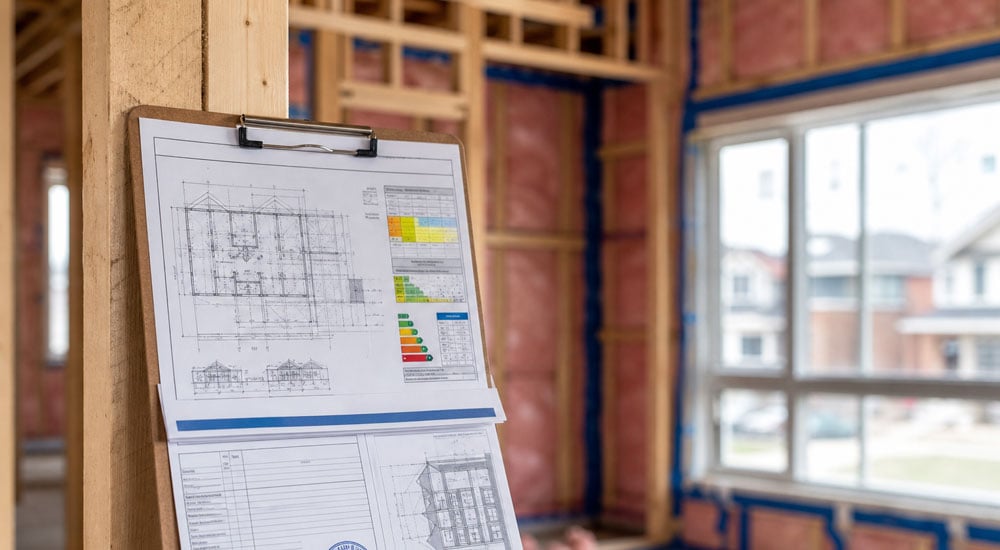
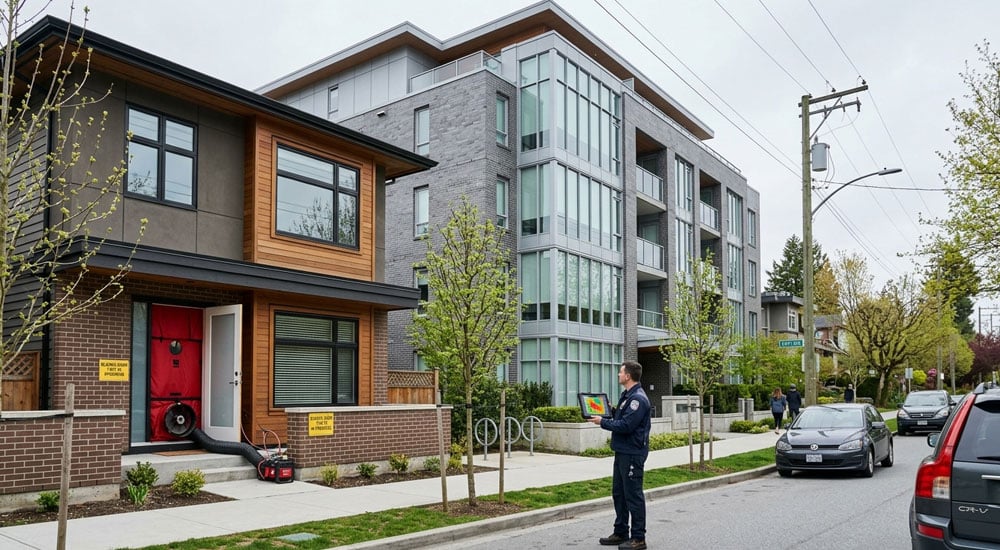
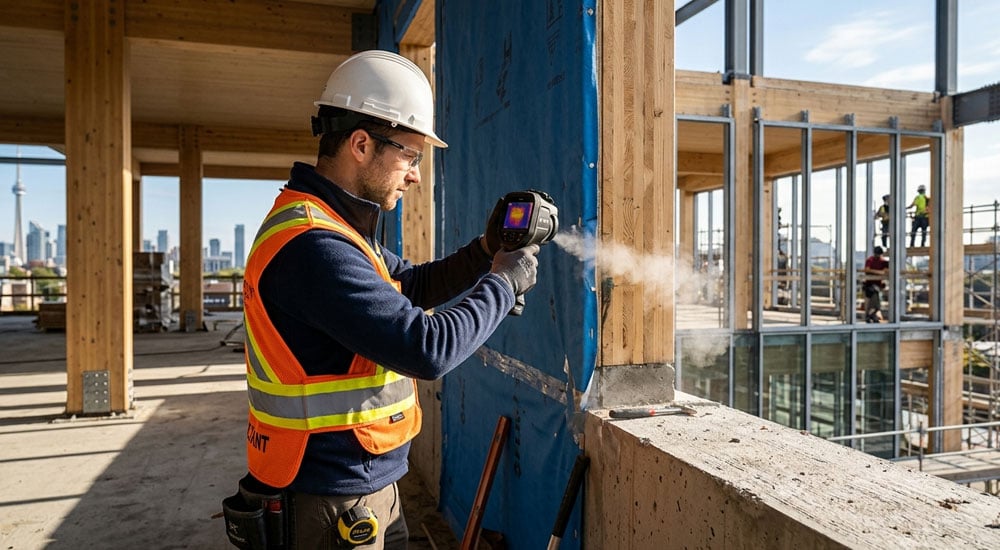
Passive House focuses on continuous insulation, triple-glazed windows, airtight construction verified by blower door testing, and heat recovery ventilation. The combined effect is a home where the heating system has very little work to do.
This is increasingly relevant as provinces adopt tiered energy codes, such as BC’s Energy Step Code, whose higher tiers overlap with Passive House performance targets. Adoption isn’t uniform, and requirements can vary significantly between municipalities. For homeowners in Ottawa or Montreal, the main benefit is stable indoor temperatures during extended cold spells.
One clarification worth making: Passive House reduces heating load dramatically, but it doesn’t remove the need for a heating system entirely. A smaller heat pump or electric backup is still typical. What changes is how rarely that system needs to run, and how small it can be sized.
What Net Zero Actually Requires in Practice
A Net Zero home is designed to produce as much energy on-site, over a full year, as it consumes. In Canada, this is typically verified through an EnerGuide rating and the CHBA’s Net Zero Home Labelling Program.
In practice, this usually means a moderately upgraded envelope (though not necessarily to Passive House levels), a cold-climate heat pump, and a rooftop solar array sized to the home’s projected annual load. Location changes the math. Homes in southern Ontario and the Okanagan Valley often require smaller solar arrays due to stronger solar access. Shaded properties or regions with limited winter daylight may require larger arrays, with summer surpluses offsetting winter deficits.

A few practical factors tend to influence whether a Net Zero home meets its targets:
- Roof orientation and pitch relative to true south, not just total roof area
- Provincial net metering rules, since Ontario, Alberta, and BC each structure excess-generation credits differently
- Snow accumulation on panels, which can reduce output for stretches during winter in higher-snowfall areas
- Whether the design includes battery storage or relies on net metering, which remains the more common approach in Canadian Net Zero builds
- The home’s actual occupancy and usage patterns, since modelled performance and real-world performance can diverge if the household uses more energy than the design assumed
That last point is one that often gets overlooked. A Net Zero label reflects a modelled balance under specific assumptions, so a household that runs a hot tub year-round or charges an EV daily may need a larger system than the baseline model suggested.
Cost, Incentives, and What to Verify Before Committing
The cost gap between the two approaches has narrowed somewhat as solar panel prices have declined and as building codes have pushed standard construction closer to higher-performance envelopes regardless of which path a homeowner chooses.
Passive House tends to carry a higher premium, largely tied to window costs and the labour involved in achieving and testing airtightness. Net Zero costs vary more by site, since the solar component is the main variable.
On incentives, it’s worth being direct: federal programs like Canada Greener Homes have supported retrofit measures such as insulation, air sealing, and heat pump upgrades in the past, but program details, eligibility, and funding availability have changed over time and shouldn’t be assumed to be active without checking current information directly through NRCan or your provincial energy office. The same applies to provincial programs, some of which have been adjusted, paused, or replaced since their initial launch.
For long-term value, Passive House homes tend to have very stable, low heating costs regardless of weather extremes, since the building itself does most of the work. Net Zero homes can see more variation month to month tied to solar output, with the annual total being the figure that matters for the Net Zero claim itself.
Passive House vs Net Zero: Which Is Right for Your Home
For homes in regions with harsh winters and limited solar access, an envelope-first approach tends to deliver more predictable results, since performance doesn’t depend on how much sun the roof gets in January. For properties with good solar exposure and a homeowner comfortable with a system that depends partly on generation, the Net Zero path can work well, particularly where local net metering policy makes excess generation worthwhile.
Some builders now combine elements of both: an envelope that’s tighter than code minimum but not necessarily certified Passive House, paired with a right-sized solar array. This hedges against both higher heating costs and underperforming solar in any given year, though it’s worth asking a builder directly whether they’ve delivered this kind of hybrid project before, rather than assuming it’s a standard offering.
Conclusion
Passive House and Net Zero are two different strategies aimed at the same outcome: a home that costs less to run and performs better through a Canadian winter. Passive House invests upfront in the envelope and ventilation system, paying off through consistently low heating demand that aligns with where higher-tier provincial energy codes are heading. Net Zero pairs a solid but less extreme envelope with solar generation verified through an EnerGuide rating and the CHBA’s labelling program, and tends to work best where roof orientation and local solar access cooperate. Before deciding, talk to a builder who has direct experience with the standard you’re considering in your specific municipality, confirm which code tier applies to your project, and check current program details with NRCan or your provincial energy office rather than relying on past incentive structures that may no longer be in effect.