When building to Passive Home standards in Canada, windows are one of the most consequential decisions you’ll make. They affect how much heat stays in during a Winnipeg winter, how comfortable a room feels on a Vancouver afternoon, and whether your mechanical system can stay as minimal as Passive House design intends. Most people focus on insulation or airtightness first — and those matter — but windows are where thermal performance, solar strategy, and construction detail all have to work together at once.
A poorly placed window, even a high-performance one, can undermine the entire thermal envelope. The challenge in Canada is that no single window strategy works coast to coast. A south-facing glazing strategy that performs well in Edmonton’s dry cold behaves differently in Toronto’s mixed-humid climate or on the BC coast, where overcast winters reduce solar availability considerably. What separates a thoughtfully designed Passive House from one that just checks certification boxes is how well the window decisions are matched to the actual site, climate zone, and energy model — not just a general rule about orientation or glazing type.
Window Orientation and Placement in Canadian Climates
In Canada’s heating-dominated climates, south-facing glazing generally receives the most useful solar exposure during winter, when the sun sits lower in the sky. But this principle has real limits. Cloud cover, neighboring buildings, site topography, and the window-to-wall ratio all affect how much solar gain is actually achievable — and how much of it creates overheating risk in shoulder seasons.
The general approach in Passive House design is to concentrate glazing on the south facade, keep north-facing windows modest, and handle east and west exposures carefully. North-facing windows contribute daylight without meaningful solar gain, and depending on the U-value of the assembly, they can represent a measurable heat loss. West-facing glazing is the trickiest exposure in mixed climates: afternoon sun in summer can cause significant overheating, particularly in southern Ontario and the BC interior, and exterior shading — fixed overhangs, exterior operable blinds, or deciduous trees — is usually part of the solution.
The relationship between window placement and thermal mass matters here too, though Passive House design doesn’t require heavy mass construction. When thermal mass is present — a concrete slab, masonry wall — it can absorb solar heat through south glazing and release it gradually. In lightweight assemblies, the same solar gain can cause temperature swings unless glazing area and shading are carefully modelled. Placement decisions can’t be made in isolation from the rest of the building’s energy strategy.
Glazing Specification: U-Value, SHGC, and What the Numbers Mean
| Window / Glazing Category | Typical U-Value (W/m²K) | Typical SHGC | Notes |
| Double glazed (standard) | 1.8 – 2.8 | 0.25 – 0.45 | Typically not suitable for Passive House performance |
| Double glazed (low-e) | 1.2 – 1.6 | 0.20 – 0.40 | Common in mid-range construction |
| Triple glazed | 0.5 – 0.8 | 0.40 – 0.55 | Approximate center-of-glass range; varies by coatings, gas fill, spacer, and test standard |
| PHI-certified (whole-window) | ≤ 0.80 | Varies by orientation | Whole-window value including frame; additional criteria apply |
In most Canadian Passive House projects, triple glazing is the practical baseline. The additional pane — combined with two low-emissivity coatings and an argon or krypton gas fill — significantly reduces heat loss through the glazing unit. In climates where temperatures regularly drop to -20°C or below, a well-specified triple-glazed unit keeps the interior glass surface much warmer than conventional double glazing, reducing the mean radiant temperature effect that creates downdraft risk and discomfort near windows.
One important distinction the table above reflects: center-of-glass U-values and whole-window U-values are not the same. The frame conducts heat independently, and Passive House certification evaluates the whole-window assembly. A glazing unit that performs well at the center of glass can still fall short if the frame pulls the whole-window value above the threshold.
The solar heat gain coefficient (SHGC) is equally important, and the right value depends on more than orientation alone. Optimal SHGC is determined by climate zone, window-to-wall ratio, presence of exterior shading, internal gains, and the overall energy model. As a general direction, south-facing windows in heating-dominated Canadian climates benefit from a higher SHGC — typically 0.50 or above — to capture useful solar heat through winter. But specifying a high SHGC without adequate exterior shading on south or west exposures can cause overheating in summer that requires active cooling rather than relying on ventilation alone.
Airtight Installation and Thermal Bridging at the Frame Junction
Even a certified high-performance window loses much of its value if the installation detail is poor. The junction between the window frame and the wall structure is one of the most common failure points in Passive House construction — not just for energy performance, but for moisture risk. In Canadian winters, air leakage at this junction creates conditions for condensation inside the wall assembly, which in cold-climate construction can cause lasting damage.
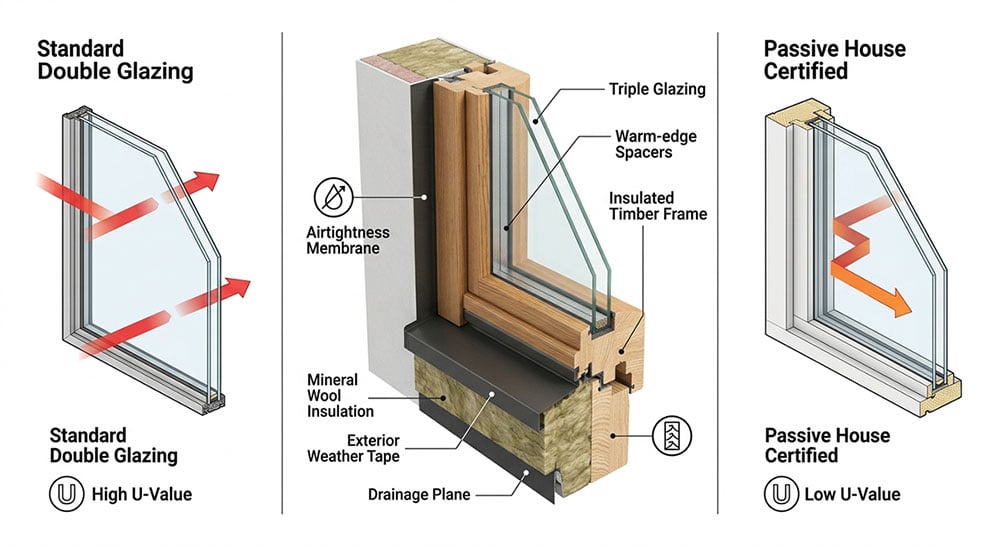
A well-executed Passive House window installation typically involves:
- Positioning the window within the insulation plane rather than in the structural wall, to minimize thermal bridging at the perimeter
- Using pre-compressed sealing tape or fluid-applied membranes on the interior side to maintain continuity of the airtight layer
- Applying vapour-open, weather-resistant tape on the exterior, where compatible with the wall assembly’s vapour-control strategy, to allow outward drying
- Detailing the sill to manage drainage and prevent water from tracking back into the wall
- Thermally breaking mounting brackets, anchors, and any load-transfer elements between the frame and the structural opening
Thermal bridging at the window perimeter is quantified as a linear thermal transmittance value — the psi (ψ) value — derived from thermal modelling of the specific installation detail. Poor detailing of reveals, sills, fasteners, and mounting systems all contribute to a higher psi value, which affects the overall heat loss through the fenestration assembly. In Passive House energy models, these values are explicitly accounted for, which means on-site installation quality has a direct and measurable impact on whether the building performs as designed.
Certified Passive Home Windows and the Canadian Context
PHI certification and PHIUS certification are not the same standard, and understanding the difference matters for Canadian projects. PHI — the Passive House Institute, based in Germany — is commonly associated with a whole-window U-value around 0.80 W/m²K for cool-temperate certification, though PHI component certification also considers additional criteria including frame class, glazing edge effects, and minimum interior surface temperature. PHIUS, a North American Passive Building certification organization, uses a climate-specific methodology that adjusts performance targets based on local heating and cooling loads. The two frameworks can lead to different specification decisions for the same project, and in some colder Canadian climates, the requirements are more demanding than the European benchmark.
For Canadian builders and designers, this distinction has practical implications. Working with a supplier or energy consultant familiar with the applicable standard early in the design process affects product selection, documentation, and schedule. Lead times deserve attention on their own. European manufacturers have supplied the certified Passive House window market longer and carry broader product ranges, but North American producers have grown considerably. In prairie markets specifically, sourcing and installer familiarity can be genuinely limited — some regions have fewer certified installers, and rural projects often need earlier procurement planning than urban ones. Coastal projects bring their own considerations around moisture detailing that differ from the dry-cold assemblies common on the prairies.
Conclusion
Passive House windows are a system, not a product selection. Where they go determines how much solar energy the building captures and loses. What the glazing does depends on the full specification — U-value, SHGC, frame performance, and how those interact with the specific climate zone and energy model. How the window is installed determines whether the certified performance of the unit is actually realized in the building. The most common mistake in Canadian Passive House projects isn’t choosing the wrong window — it’s treating these decisions as separate line items rather than as one interconnected assembly that has to be right from design through to the last piece of tape on site.