Step Code documentation can delay a project even when the building itself is capable of meeting its energy performance target. In many BC municipalities, permit reviews do not fail because the design is weak; they come back because the energy model, drawings, mechanical specifications, airtightness strategy, or municipal submission requirements do not line up clearly enough. Avoiding these permit bottlenecks requires more than a generic checklist. This guide breaks down the main reasons Step Code documentation gets rejected, including alignment failures across the three compliance stages, municipality-specific requirements, and the role an energy advisor plays in keeping modelling, testing, and as-built verification coordinated from the start.
For builders navigating these requirements, greencanadaenergy bridges the gap between technical compliance and onsite realities. We help ensure energy modelling, blower door testing, and municipal paperwork operate as one coordinated system, reducing surprises at permit review and final verification.
Why Step Code Documentation Gets Rejected in BC
Disconnects between design files and energy software delay more permit timelines than actual building performance limits. Municipal permit reviewers do not just check whether a building is efficient; they review whether the submittal package is technically consistent across drawings, schedules, calculations, and the HOT2000 energy model. When a file comes back with a Request for Information (RFI), correction request, or rejection, it is often because the architectural plans, mechanical specifications, and energy model are telling different stories.
To clear municipal review without delays, project teams need to eliminate three common alignment failures before submission:
- Floor Area Mismatches (CFA): The Conditioned Floor Area calculated from the architectural drawings does not match the heated floor area, volume, or conditioned-space inputs entered into the HOT2000 energy model. Even small discrepancies in conditioned-space calculations can trigger an RFI, correction request, or rejection.
- Glazing Specification Gaps: Architectural window schedules show one set of ratings, while the HOT2000 energy model uses product performance data that does not clearly match the submitted window package. When NRCan/ENERGY STAR product data, NFRC ratings, CSA A440.2-based labels, or tracking information do not align between the compliance report and architectural specifications, reviewers can flag the file.
- Vague Mechanical Details: Mechanical schedules, ventilation specifications, and equipment assumptions do not clearly reflect the systems used in the energy model. Most importantly, the submission may fail to align the model with CSA F280-12 heat loss and heat gain calculations, creating equipment-sizing discrepancies that trigger correction requests.
Under the BC Energy Step Code framework, compliance documentation is a strict coordination task. Builders lose weeks not because their assemblies cannot perform, but because their paperwork fails to document the compliance path accurately. A qualified energy advisor reduces this risk by cross-checking architectural drawings, mechanical specifications, fenestration data, CFA inputs, and HOT2000 metrics before the permit package reaches a municipal reviewer.

Common Step Code Documentation Mistakes Builders Make
When a Step Code package is flagged during municipal review, the rejection is rarely caused by a single major design flaw. Instead, it is usually the result of small, cumulative discrepancies across different consulting files.
The table below outlines the five most frequent documentation errors caught by BC permit reviewers and how to prevent them from stalling your project:
| Common Documentation Error | Technical Risk / Why Reviewers Flag It | The Corrective Action |
| Drawing & Model Mismatches | Architectural drawings show one window configuration, while the HOT2000 model utilizes different U-values or dimensional schedules. | Ensure the energy advisor cross-checks the final architectural IFC (Issued for Construction) drawing set before generating the compliance report. |
| Vague Air Barrier Details | The energy model relies on an aggressive target (e.g., 1.5 ACH @ 50Pa), but drawings lack a detailed, continuous air barrier strategy. | Clearly map out air barrier continuity on your section details. Specify how transitions at rim joists, windows, and service penetrations are sealed. |
| Incomplete HVAC & Mechanical Specs | Submissions include primary furnace or heat pump efficiency but omit critical auxiliary metrics like HRV/ERV Sensible Recovery Efficiency (SRE) or heat pump HSPF2/COP ratings. | Document the complete mechanical system loop. Every efficiency metric entered into the HOT2000 software must match the mechanical engineer’s schedules exactly. |
| Outdated Climate & Location Data | Heat loss/gain calculations run under CSA F280-12 utilize obsolete weather data or incorrect regional stations, distorting mechanical sizing. | Verify that all heat load calculations strictly utilize the localized climate data stations mandated by the BC Building Code (BCBC) Appendix C. |
The Cost of Disconnect: A single mismatch between your mechanical schedules and your HOT2000 inputs will trigger a Request for Information (RFI), immediately pushing your permit review to the back of the municipal queue. Coordination before submission is always cheaper than a forced redesign.
The Three Stages of Step Code Compliance Documentation
Step Code compliance is not a single form submitted at the end of a project. It moves through three connected stages: pre-construction modelling, construction-phase verification, and final as-built confirmation. When project teams treat these stages as isolated tasks, documentation mismatches become much harder to control.
- Pre-Construction: Energy Modelling and the Pre-Construction Report
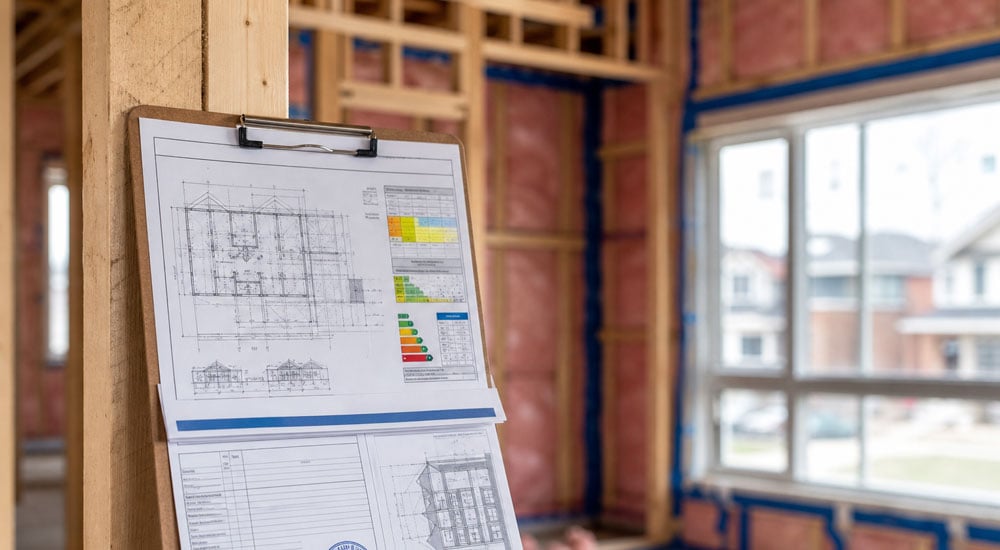
Before construction begins, the energy advisor builds the HOT2000 model using the architectural drawings, assembly R-values, glazing data, mechanical specifications, ventilation details, and expected airtightness level. This stage usually results in a pre-construction compliance report or checklist, sometimes referred to in local permitting workflows as Form A, which shows municipal reviewers how the proposed design is expected to meet the required Step Code level.
- Mid-Construction: Field Verification and Air Barrier Checks
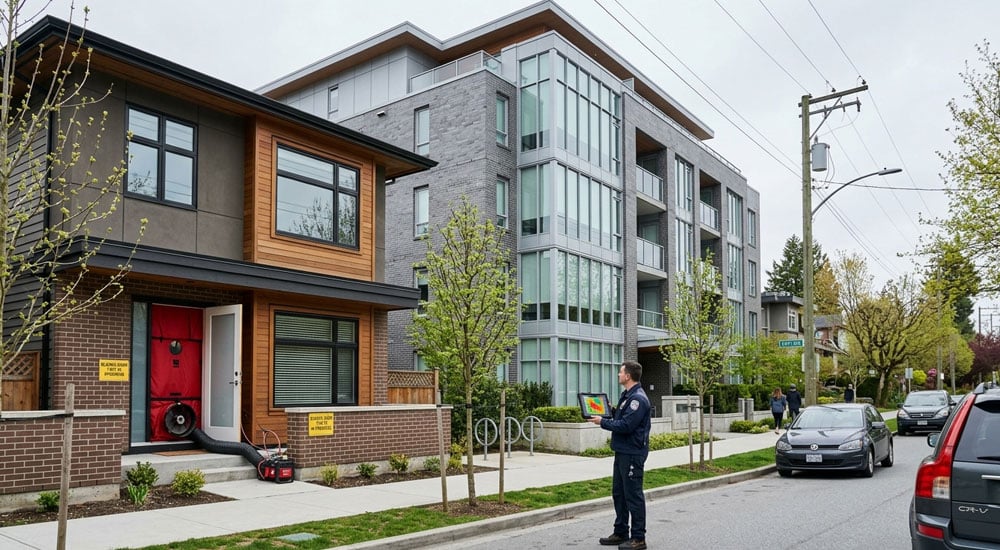
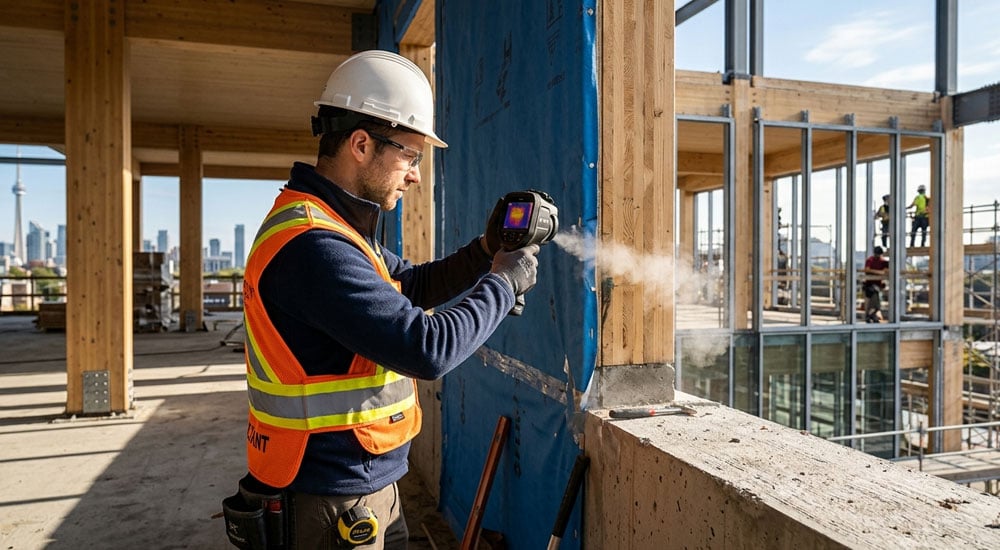
As construction moves from design assumptions to site conditions, a mid-construction blower door test can identify leakage paths before drywall or finishes conceal the air barrier. Some BC municipalities require or request mid-construction airtightness documentation, while others treat it as a risk-management step. Either way, this stage gives the builder time to correct rim joists, window transitions, service penetrations, mechanical chases, and other weak points before the final test.
- Final Verification: As-Built Confirmation and the As-Built Report
At project completion, the energy advisor performs final airtightness testing and reconciles the completed building against the permit-stage model. If installed mechanical equipment, window labels, conditioned floor area, assemblies, or airtightness results differ from the original assumptions, the energy model must be updated to reflect the as-built condition. This reconciliation is part of producing a valid as-built compliance report or checklist, sometimes referred to in local permitting workflows as Form B, for municipal review, final inspection, or occupancy approval.

The Connected Workflow: The strongest Step Code submissions treat these stages as one continuous loop. The pre-construction model sets the performance baseline, mid-construction diagnostics reduce envelope risk, and the final as-built report proves that the completed building matches the compliance path submitted to the municipality.
How an Energy Advisor Helps Submit Step Code Documentation Correctly
Submitting Step Code documentation successfully requires converting separate architectural, mechanical, and envelope designs into one coordinated compliance package. A qualified energy advisor does not just fill out paperwork; they review the full submittal to catch misaligned Conditioned Floor Area (CFA) inputs, unsupported window performance data, incomplete mechanical assumptions, and CSA F280-12 heat loss or heat gain calculation issues before they reach a municipal reviewer. As a specialized partner in local permitting workflows, greencanadaenergy provides Step Code energy advisor services, energy modelling for builders, blower door testing in BC, and Step Code documentation support. By cross-checking HOT2000 inputs against permit drawings, mechanical specifications, fenestration data, air barrier details, and municipality-specific requirements, greencanadaenergy helps reduce the technical discrepancies that trigger RFIs, correction requests, and avoidable resubmissions, giving builders a cleaner path from permit application to final as-built review.